American Aircrafs
42-31135 – Susy Sag Tits
Staande v.l.n.r.: T/Sgt Roy Kesanen, S/Sgt Will McGee, T/Sgt Jim Geraghty, M/Sgt Tom Foulds, Sgt. L. McBrayer, Sgt. Ken Haws (laatste twee niet aan boord op 6 maart 1944) Gehurkt v.l.n.r.: 2/Lt Monty Givens, 2/Lt Harry Teat, 2/Lt Ken Betts, 2/Lt Lawrence McMillian
Letter: W
Model: Boeing B17G-BO Flying Fortress
Sqn: 562BSQ
Crash oorzaak: Neergeschoten door een jachtvliegtuig
Crash Locatie: Dommerskanaal nabij Weiteveen
Tijd: 15:30
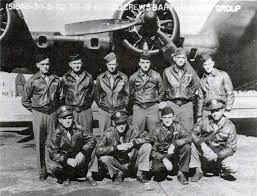
The Crew
- Vlieger: 1st Lt. Montgomery Douglas (Monty) Givens - Krijgsgevangene
- 2e Vlieger: 2nd Lt. Harry James Teat - Krijgsgevangene
- Navigator: 2nd Lt. Kenneth Hanley Betts (Overleden in Annandale, VA, USA, 24 okt. 2006) - Krijgsgevangene
- Bommenrichter: 2nd Lt. Lawrence Herman McMillian - Krijgsgevangene
- Radiotelegrafist: T/Sgt. J. Geraghty - Krijgsgevangene
- Boordwerktuigkundige: T/Sgt. Roy Eugene Kesanen - Krijgsgevangene
- Buikkoepelschutter: S/Sgt. Thomas Howard Foulds - Krijgsgevangene
- Zijkoepelschutter: S/Sgt. Willard R. McGee - Overleden
- Zijkoepelschutter: Sgt. Daniel Walstra - Krijgsgevangene
- Staartschutter: T/Sgt. Jack Edgar Karr - Krijgsgevangene
The fierce attacks of the German fighter pilots took more toll; these two B-17s of the 562nd Squadron of the 388th Group were not the only casualties here. The B-17G 42-31135 “Suzy-Sag-Tits” of the 1/Lt. Monty D. Givens, was hit during the fourth attack, just before the Dutch border. When the German flight controller of the attacking "Rotte" (two aircraft) started firing at him, he "slipped" on his attacker. This maneuver thwarted the German's carefully chosen attack position, so that it missed. But his "Rottenflieger" was more successful and with a well-placed salvo put the two starboard engines of the "Suzy-Sag-Tits" out of service. In addition, a 20mm grenade exploded in the radio cabin and near the left side hatch gunner, T/Sgt. Daniel Walstra. The radio operator, T/Sgt. James Geraghty, was hit by flying shrapnel but not seriously injured.
Aboard “Suzy-Sag-Tits”
The frontal attack prevented Tom Foulds, the ventral turret gunner, from returning fire from the attackers. He had to be content to watch for FW190s attacking from lower positions. The German fighters carried out such razor-sharp attacks that the bomber crews could see the faces of the enemy pilots as their planes "rolled" through the formation.
Sgt. Foulds: “I felt a definite jolt when our plane was hit. In the second or third attack I was wounded when 20mm shells hit my turret and exploded in it, ricocheting shrapnel through the turret. Later it turned out that I had about forty wounds in both legs and in my neck; most were small and shallow. My interphone stopped working and I could see that both starboard engines were on fire. So I opened the hatch and looked into the side hatch compartment. Sgt. Walstra was kicking open the side hatch and signaling me to follow him and get off the plane. I put on my parachute and made my way to the escape hatch. Sgt. Geraghty came after me. When I saw Sgt. McGee (the right side-door gunner) passed, he was still behind his machine gun, firing incessantly. It appeared he was uninjured.”
“Abandon Aircraft!” (Abandon plane!)
The “Suzy-Sag-Tits” was in bad shape. Two engines were on fire and there was also fire in the hull; heavy clouds of smoke entered the cockpit. It was clear that the crew had to leave the plane, but not before Givens' dorsal turret gunner, T/Sgt. Roy E. Kesanen, had hit one of the attackers (Other crew members confirmed the fighter went down). After Givens, who feared the fuel tanks would explode, the signal "abandon aircraft!" (abandoned device), the men reported one by one that they were going to jump; the tail gunner, S/Sgt. Jack E. Karr, through the small escape hatch in the tail, as he was unable to reach the center compartment due to the damage.
In the consternation Givens hadn't noticed that Sgt. McGee hadn't turned up. The bomb aimer, navigator and co-pilot all exited through the forward escape hatch. Givens engaged the autopilot and was able to keep the plane level for a while. Then, however, it started to climb and threatened to slide off. He then quickly followed the others through the hatch. Givens quickly pulled the pull bar of his parachute, which opened with a jerk. Looking around, he counted eight more parachutes so that all but one of the men had been able to get off the plane. Little did he know at the time that Sgt. McGee was killed. It is not known where Givens fell exactly.
Adventures in Drenthe peat area
“When I was able to remove my parachute and look around, I saw two other members of the crew close by: my navigator (2/Lt. K. H. Betts) and my rear gunner (Sgt. Daniel Walstra). We approached Ilaar and decided to go in opposite directions to see if we could find shelter for the night. Then two boys, about fifteen years old, approached us and took us to a nearby farm. There were two older men and some women and children. They gave us coffee and bread.
We were trying to find out if they intended to hide us when a young man in his twenties came in, spoke some English and told us to disappear like lightning. The older men, however, threw him out and stopped us with axes. Meanwhile, several people had gathered in the yard and a Dutch policeman approached us and searched us for weapons. A few minutes later a German soldier arrived on a motorbike and ordered us to follow him. On the way a teacher who followed us along with the other people told us that the farmers had turned us in for money. She said they were bad Dutch. I can only feel sorry for them now, but then I thought otherwise! We were loaded into a truck and taken to Leeuwarden, where we were interrogated. Only then did I hear that McGee was dead. Most of my crew and our roommates were there too. From Leeuwarden we were taken to Amsterdam and from there to Frankfurt, where we were assigned to Stalag I in Barth (Germany).”
Sgt. This is how Foulds went: “I jumped there after Sgt. Walstra out and waited at least a minute before opening my parachute to get off the plane and below. As I approached the ground, it became clear to me that the wind would send me into a canal. Unwilling to go into the water with all my heavy clothing and parachute, I let the air out of my parachute and landed very hard on the cobbled bank of the canal. The shock of the landing practically paralyzed me from the hips. After removing my parachute, I crawled into a grove of trees. Two local residents took me into a house and gave me first aid. Four German soldiers then arrived and took me into custody. Later, at the Frankfurt interrogation center, I was told that the body of Sgt. McGee was found in the wreckage of our plane. The cruel irony of fate had it that his twin brother, who was a gunner in another Group of the Eighth Air Force, had been killed just three days before.