DV287
AVRO Lancaster MK III, DV287, SR-N, RAF 101 sqn.
In the night of January 14th, 1944, the aircraft, participating in a raid on Brunswick as a part of a force of 498 bombers, fell prey to Oblt. Martin Drewes’ and his radio operator Uffz. Erich Handke’s fighter.
Photo courtesy of Etienne du Plessis
The German plane had departed that night at 17:55 from Leeuwarden and was guided by the air combat controller of “Eisbar” radar station near Sondel. So far, luck was not on their side that night. When the controller reported to them their position was in the bomber stream, they saw the first bomber flying by in the oposite direction at a distance of about 1000 feet. While turning in, they observed several other aircraft overflying them at about 1000 to 1500 feet above. However, they lacked the ability to attempt an attack, primarily because their aircraft was still equipped with the old “Lichtenstein” equipment, which was jammed by Window.
But around six thirty, their tide would turn. Their combat controller guided them to an enemy bomber until they had a visual of an opponent flying at an altitude of 19.500 feet. Apparently the bomber was not aware of the night fighter sneaking up on her, as it steadily maintained its heading. Handke reported the “Pauke, Pauke!” to the ground station. The barrels spit bullets.
Almost immediately the port wing caught fire, whereupon also fire broke out in the fuselage of the bomber. A moment later the aircraft plunged into the depth, fully ablaze, and exploded jus above the ground. “12 miles northeast of Meppel”, Handke wrote in his logbook. It was 18:30 hrs, thirty minutes before “Hour 0”, the start of the attack that was set at 19:00 hrs. It was the last “Abschuss” that Drewes and Handke booked with normal armament (in the nose of the aircraft); after that day their machine was equipped with the so-called “Schrage Musik” – upward tilted guns, mounted in the back of the airplane. These would make redundant the traditional and fairly dangerous way of attack from behind. Using “Schrage Musik”. the nightfighter would shift underneath the bomber at a perpendicular heading, the bomber being blind on the underside as it was not equipped with a ball turret as the American bombers had. The rest was fairly simple: the visor was set, often on the wing tanks and a push on the buttons would do the trick. Many bomber crews must have not the faintest idea in those last moments with what and how fate had struck them so suddenly.
Mr. Jac. Hoving, presently living in Emmen, on whose land, at the Westra’s Wijk near the border village Klazienaveen, parts of the aircraft came down, reports: “It must have been approximately five ‘o clock in the late afternoon and we were about to have supper. Suddenly a bright light shone outside and we heard a terrible noise. It appeared to be a burning aeroplane, that had barely missed our farmhouse. When we got outside it just exploded on, or better said in the ground, about half a mile behind our farm. It was as if the whole area was on fire. Hoving, who kept people in hiding, decided it would be wise to remain inside for the time being.
Eight crewmembers died in the crash. One of the bodies, that apparently was undamaged, had ended up close to the farmhouse. “It was a handsome young chap”, Hoving remembered. “He wore a parachute and had been smashed into the soft soil (a sister who was his spitting image visited us years later).” The fact that the man wore a parachute indicates that the crew had been on the brink of evacuating their aircraft – unfortunately they had not succeeded. Their bodies were coffined on the spot and were buried in the cemetery of Nieuw Dordrecht. One crewmember however, managed to bail out and escape, partly due to the fact that he was supernumerary to the standard seven to eight headed crew. His name was Alex Walmsley.
The Lancaster was completely destroyed – the burnt wreckage pieces were cleared by a gang of workmen under supervision of the Germans. Mr. T Groenwold, who owned a few large lorries, was ordered to transport the debris off the land.
Entry from the original RAF War diary on that date
14/15 January 1944
496 Lancasters and 2 Halifaxes on the first major raid to Brunswick of the war. 38 Lancasters lost, 7.6 per cent of the force. The German running commentary was heard following the progress of the bomber force from a position only 40 miles from the English coast and many German fighters entered the bomber stream soon after the German frontier was crossed near Bremen. The German fighters scored steadily until the Dutch coast was crossed on the return flight. 11 of the lost aircraft were Pathfinders. Brunswick was smaller than Bomber Command’s usual targets and this raid was not a success. The city report describes this only as a ‘light’ raid, with bombs in the south of the city which had only 10 houses destroyed and 14 people killed. Most of the attack fell either in the countryside or in Wolfenbüttel and other small towns and villages well to the south of Brunswick.
82 aircraft – 59 Stirlings, 13 Halifaxes, 10 Mosquitos – attacked flying bomb sites at Ailly, Bonneton and Bristillerie without loss.
11 Mosquitos to Magdeburg and 6 to Berlin, 9 RCM sorties, 2 Serrale patrols, 29 aircraft minelaying off Brest and in the Frisians, 36 OTU sorties. No losses.
Total effort for the night: 673 sorties, 38 aircraft (5.6 per cent) lost.
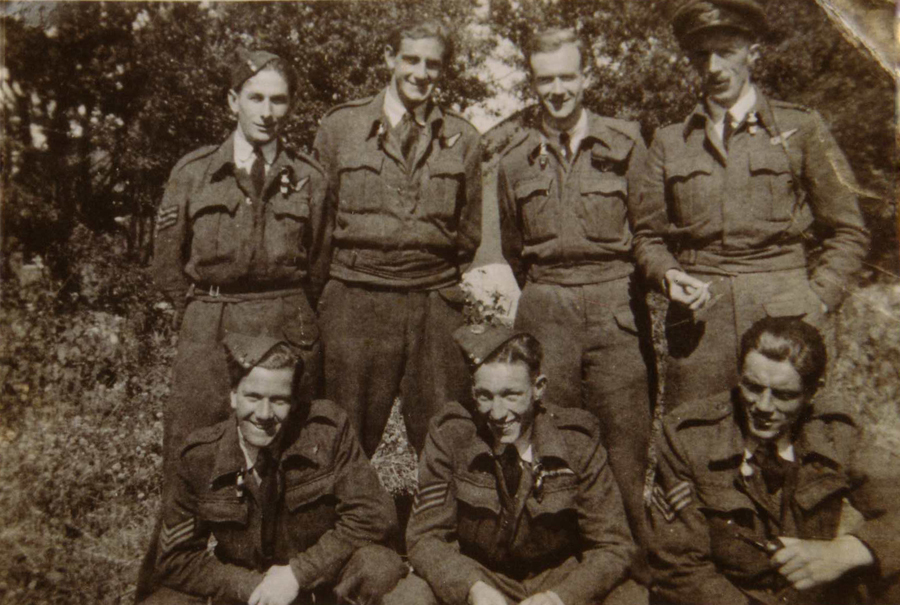
The Crew
f.l.t.r. boven: Len Easdon, Pete “Jock” Mitchell, Stan Watchorn, J.R. Preedy (geen crewmember ten tijde v/d crash), onder: George McLatchie, Joe Slater, Arthur Schneider
- Stanley E. Watchorn
- Leonard Easdon
- Arthur W.K. Schneider
- John F. Stafford
- Peter Mitchell
- Maxwell C. Patterson
- George T. McLatchie
- Alexander H. Walmsley